Last Updated: November 17, 2026
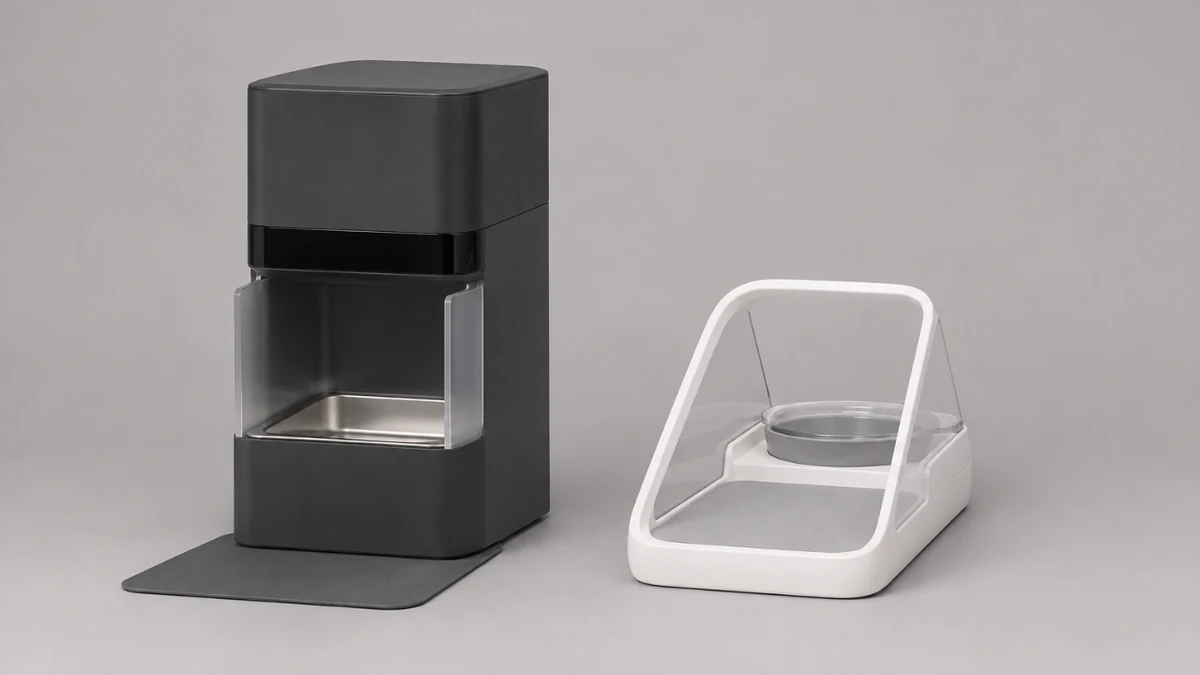
The featured image is an AI-generated illustration of two of the products discussed, not a photo of units we handled. We did not physically test them. Appearance, colors and scale may vary.
Makers’ official pages, FAQs, and manuals checked November 9, 2026. Amazon listings checked November 9, 2026. We did not test these feeders; we compared published specs from each maker’s own pages.
AI disclosure: BestPetPicker Research prepared this page with AI assistance and checked each fact against the maker pages listed under Sources.
If one cat keeps eating another cat’s food, or one cat eats a different food from the rest, a selective feeder keeps its lid closed until a cat it recognizes comes to eat. This guide covers three: Sure Petcare’s SureFeed Microchip Pet Feeder, the SureFeed Microchip Pet Feeder Connect, and the PETLIBRO One RFID Pet Feeder, using only what each maker publishes for its U.S. model. For timed feeders that serve any cat, see our automatic cat feeder guide.
Short answers
- How they recognize your cat: both SureFeed models read your cat’s implanted microchip or a Sure Petcare RFID collar tag. The PETLIBRO One RFID reads only its own collar tag: “The feeder is NOT compatible with a pet’s microchip.”
- Cats per feeder: each SureFeed feeder stores up to 32 pets. Each PETLIBRO One RFID links to one collar tag, so “two pets cannot share a feeder.”
- Guarding a bowl or serving meals: the SureFeed Microchip Pet Feeder has no timer; you fill the bowl and the lid opens for registered pets. The PETLIBRO One RFID also serves scheduled meals from a 3-liter food tank. For the Connect, see the timed-meals table below.
- Food: both SureFeed models take wet or dry food; the PETLIBRO is for dry food only.
- Limits: Sure Petcare says “it is not possible to fully guarantee the exclusion of all other pets in all circumstances,” and sells a rear cover for pets that steal from behind.
The three feeders side by side
Models covered (maker’s code): SureFeed Microchip Pet Feeder (MPF001) · SureFeed Microchip Pet Feeder Connect (iMPFWT; sold with the Hub as iMPFWTB1) · PETLIBRO One RFID Pet Feeder (PLAF301).
How each one recognizes your cat
| Feeder | Reads | Pets per feeder |
|---|---|---|
| SureFeed Feeder | Implanted microchip or Sure Petcare RFID collar tag (one tag included) | Up to 32 |
| SureFeed Connect | Implanted microchip or Sure Petcare RFID collar tag (one tag included) | Up to 32 |
| PETLIBRO One RFID | Its own RFID collar tag only (one included) | 1 collar tag |
Food and power
| Feeder | Food | Power |
|---|---|---|
| SureFeed Feeder | Wet or dry; 400 ml bowl | 4 C batteries (not included), about 6 months |
| SureFeed Connect | Wet or dry; 400 ml bowl | 4 C (LR14) alkaline batteries, about 6 months |
| PETLIBRO One RFID | Dry only; 3 L food tank | Wall power; 3 D alkaline batteries as backup (not included) |
Timed meals and controls
| Feeder | Timed meals | Controls |
|---|---|---|
| SureFeed Feeder | No timer | 3 controls on the back of the feeder |
| SureFeed Connect | Ask Sure Petcare | 5 buttons on the back; Sure Petcare app through the Hub (sold separately) |
| PETLIBRO One RFID | Yes, scheduled in the app | PETLIBRO app; 2.4 and 5 GHz Wi-Fi |
Each cell uses the maker’s own figures and units. Where a cell reads Ask Sure Petcare, check with Sure Petcare before you buy.
Two different jobs: guarding a bowl or serving meals
A selective feeder decides who can eat. A timed feeder decides when food comes out. The SureFeed Microchip Pet Feeder does only the first job, and its manual says so directly: “NO TIMER FUNCTION: This product does not contain a timer and does not have any time related functionality.” You fill the bowl yourself. “The lid opens when a registered pet approaches” and “The lid remains closed for unauthorised pets”. Sure Petcare also tells owners not to “rely on this product to sustain them for any prolonged periods of time – no longer than 24 hours for a cat”.
The Connect adds scales and an app, but you still fill the bowl by hand: “Integrated scales weigh your pet’s food and LEDs guide you to serve food portions within 1g of accuracy.” If you need the Connect to open only at set times, ask Sure Petcare before you buy.
The PETLIBRO One RFID does both jobs. You “Schedule customized meals through the app with ease, setting the time and quantity,” and the feeder drops portions into a covered bowl that opens for the cat wearing the paired tag. PETLIBRO gives one PLAF301 portion as about 20 ml (1/12 cup), and adds, “Scheduled meals continue even during network errors.”
Microchip or collar tag?
- SureFeed (both models): Sure Petcare’s U.S. comparison chart marks both feeders “Compatible with all Common Microchips” and “Compatible with the Sure Petcare RFID Collar Tag,” and its U.S. product page lets you check your cat’s chip number: “check yours is compatible by entering the number below.” The chip is read when your cat’s head is inside the hoop at the front, so “it is important to ensure that your pet places their head through the hoop to eat.” If the feeder won’t read your cat’s chip, Sure Petcare says: “Please check with your vet to ensure that your pet’s microchip is working and that it is located in the normal place.” The included collar tag is the fallback.
- PETLIBRO One RFID: “The radio-frequency identification (RFID) reader verifies your pet’s collar tag (not microchip), before unlocking the lid to serve food”. PETLIBRO’s FAQ adds: “Currently, this feeder supports RFID collar tags but does not yet recognize implanted microchips.” The tag weighs 4.2 g and comes “on a snap-release collar”.
- Collar safety: if you use Sure Petcare’s tag instead of the chip, its manual says the tag “should be used with a safety collar which incorporates a breakaway buckle (cats only).”
- Cat size: PETLIBRO says, “The feeder fits most cats and small dogs. Pets that are too tall will have poor or no recognition of the collar tag.” Sure Petcare gives the SureFeed Microchip Pet Feeder’s eating area as 8 1/4 in wide by 6 1/8 in high.
How many feeders do you need?
- SureFeed: Sure Petcare’s advice is “We recommend that each pet has their own feeder.” The memory still allows sharing: “If you want to use the feeder for more than one pet, you can do this by repeating the process.” Cats registered on the same SureFeed can all eat from it, while it stays shut for the rest.
- PETLIBRO One RFID: “Each feeder can only be linked to one RFID collar. Therefore, two pets cannot share a feeder.” For several cats, “you’ll need to purchase multiple RFID feeders and each pet will need to wear their collar tag.”
- Spacing: PETLIBRO asks that multiple One RFID feeders be “placed at least 10 inches (25 cm) apart to prevent signal interference.” Its pairing help adds, “Make sure there are no metal objects or electronic devices close to the feeder that could potentially interfere with the RFID signal.” Sure Petcare says, “If you have more than one cat, do not place their feeders directly next to each other.”
To count, list which cats must stay away from each bowl. With the PETLIBRO, every cat that needs its own locked bowl needs its own feeder and tag. With SureFeed, Sure Petcare’s advice is one feeder per pet; registering two cats on one feeder lets both of them eat from it.
What these feeders can’t promise: limits the makers state
- No lid is a perfect lock. Sure Petcare’s manuals for both SureFeed models say “it is not possible to fully guarantee the exclusion of all other pets in all circumstances.”
- Stealing from behind or the side. The Connect manual says that “if greedy pets are managing to steal food by going around the back or the side of the feeder (when the lid is open and the authorised pet is eating) then we have created a rear cover that will help stop such clever and determined behaviour.” Sure Petcare’s U.S. page lists the Rear Cover as compatible with both SureFeed models.
- Lid timing. On the SureFeed Microchip Pet Feeder, a slider underneath sets the delay before the lid closes: “If other pets are stealing the food after the learnt pet has finished eating, slide the slider to (I) for a shorter delay before the lid closes.” On the Connect, “you can increase/decrease the time it takes to close in the Sure Petcare App.” PETLIBRO says, “You can adjust the lid closing speed and time using the Petlibro app.”
- Training leaves food open. Sure Petcare: “When training multiple pets to use their feeders, they will be able to access each other’s food, until the later stages of training.” The training mode “has four stages, and each stage partially closes the lid by different amounts.”
- A blocked lid on the PETLIBRO. “If another pet tries to access the food and prevents the lid from fully closing, the lid will briefly open to prevent injury and then attempt to close again.” After the third try, PETLIBRO says “the lid will be in a failed-to-close state” and the app sends a notification.
- Pets that keep finding a way in. For the Connect, Sure Petcare asks owners to “contact our customer care team to discuss custom settings”.
- Indoors only. Sure Petcare: “The Feeder is designed for indoor use only.” PETLIBRO’s manual: “Do not use the feeder outdoors.”
SureFeed Connect: what the Hub and app add
- Hub: “The Microchip Pet Feeder Connect requires connection to the Hub.” The Hub “is connected to the internet via an Ethernet cable”, and “Each Hub can connect up to ten devices, including our connected doors.”
- Distance: “If you have a Microchip Pet Feeder Connect, you will need to ensure that it is within 10 metres of the Hub.”
- App: “Receive notifications and view the frequency, duration and times that your pet feeds within the app.” You can “set up two different food types and set the portion amount or set the training mode and lid close delay.”
- If the internet drops: “If your Hub loses internet connection for any reason, your Microchip Pet Feeder Connect will still function as normal and retain its settings.”
- Bowls: the U.S. page lists a 400 ml bowl; the manual says the single bowl “can hold 250g, which is enough for at least 2 wet food pouches.”
PETLIBRO One RFID: power and kibble
Power: the U.S. page lists “Corded Electric; or backup power provided by 3 x alkaline D batteries (not included in the box)”, and the manual says “the batteries can only be used as an emergency plan.” PETLIBRO describes battery mode two ways. The manual says that in battery mode the RFID recognition, “Wi-Fi function, and feeding function are enabled; all other functions are disabled.” The pre-sale FAQ says that “with battery power only, the feeder cannot connect to the internet and will only perform a basic feeding schedule.” Ask PETLIBRO whether the app works on batteries before you count on it in an outage.
Kibble: the U.S. page lists a compatible kibble size of 2-15mm, while the manual (V1.0) says “Recommended kibble size: 2-18mm (0.07-0.7in) in diameter.” If your kibble is over 15 mm, ask PETLIBRO before you buy. It is a dry-food feeder: “Do not use canned, wet, or moist food.”
See the One RFID Pet Feeder (PLAF301) on PETLIBRO’s site.
Check the PETLIBRO One RFID Pet Feeder on Amazon
Which feeder fits which situation
- Your cats are microchipped and won’t wear collars: the SureFeed models read implanted microchips; the PETLIBRO One RFID needs its collar tag.
- Your cat eats wet food or eats a little at a time through the day: both SureFeed models take wet or dry food and open for registered pets; the PETLIBRO is dry food only.
- You want meals at set times, behind a lid: the PETLIBRO One RFID schedules meals in its app. The SureFeed Microchip Pet Feeder has no timer; for the Connect, see the timed-meals table.
- Several cats eat the same food and one animal must stay out: one SureFeed feeder can hold several registered pets (up to 32). (Sure Petcare still recommends one feeder per pet.) A PETLIBRO One RFID links to one tag, so each cat with its own bowl needs its own feeder.
- You want a record of visits: the Connect app shows “the frequency, duration and times that your pet feeds”; PETLIBRO’s app gives “eating pattern insights, such as time and frequency”.
FAQ
Can I use one to keep a special diet away from my other cats?
A selective feeder controls which registered pets reach the bowl; it can’t decide what your cat should eat. Sure Petcare describes the access side: “Make sure pets on prescription or life-stage diets have exclusive access to their food”. It also tells owners, “you accept full responsibility for supervising the administration of any food that could cause harm to other pets if consumed unintentionally”, and during training other pets can reach each other’s food. Sure Petcare also says “it is not possible to fully guarantee the exclusion of all other pets in all circumstances.” Sure Petcare’s U.S. pages add: “Sure Petcare products are not intended to diagnose, cure, treat or prevent diseases or conditions and do not replace veterinary care.” Ask your veterinarian about your cat’s diet.
How long does training take?
Sure Petcare says: “The amount of time required at each stage will vary for each pet (days/weeks) but we recommend taking a few days for each step.”
Do I still need a timed feeder?
If your cats need meals at set times and no bowl needs guarding, a timed feeder may be all you need. Our automatic cat feeder guide compares kibble limits, smallest portions, and what keeps working in a power cut.
Setting up a home with several cats?
Our guide to automatic litter boxes for multiple cats compares six models, including how they tell cats apart.
Sources
- Sure Petcare (U.S. site): Microchip Pet Feeder · Microchip Pet Feeder Connect · SureFeed comparison chart · Microchip Pet Feeder support page and its manual for serial #0400000+ · Microchip Pet Feeder Connect support page and its manual · training tips · where to put the feeder (checked November 9, 2026)
- PETLIBRO (U.S. site): One RFID Pet Feeder · How the One RFID Pet Feeder works (PLAF301) and the PLAF301 user manual linked from it · pre-sale questions · implanted microchips · lid closes slowly · collar tag pairing · portion sizes (checked November 9, 2026)
We did not test these feeders. Specs come from each maker’s pages on the date shown and can change; check the maker’s page and manual for your exact model code before you buy. Amazon sellers and stock also change. For questions about your cat’s diet or health, ask your veterinarian.